
 Myopia management
 Dry Eye Treatment

Spectral Domain vs. Swept Source OCT: What’s the Difference?
Blog:Spectral Domain vs. Swept Source OCT: What’s the Difference?
Spectral Domain vs. Swept Source OCT: What’s the Difference?
Spectral Domain vs. Swept Source OCT: What’s the Difference?
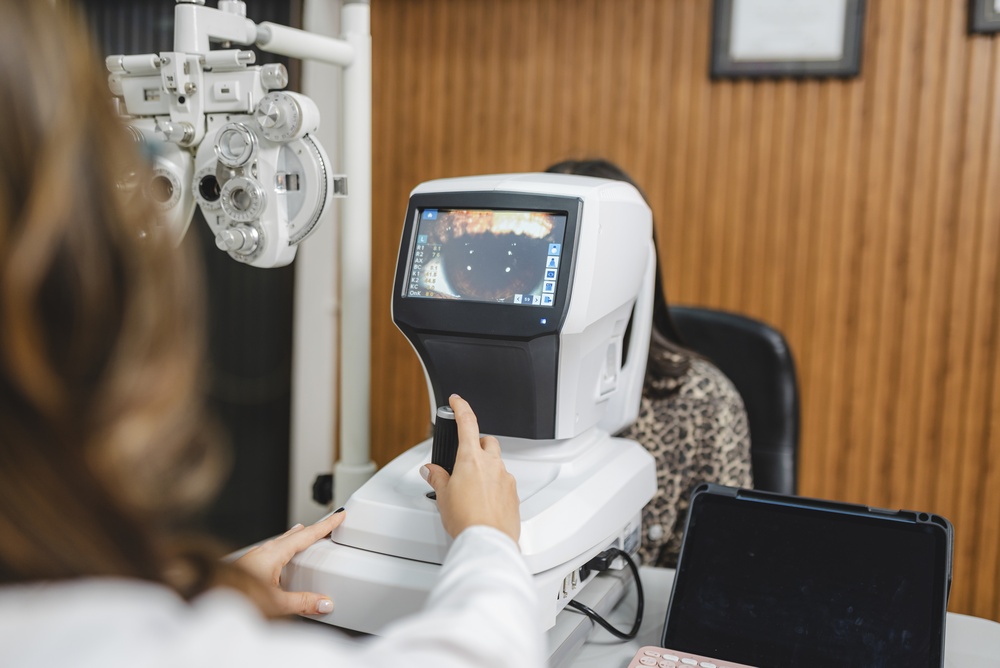
Have you ever had an eye exam where your doctor asked you to rest your chin on a machine and stare at a light? That machine was likely an OCT scanner. It takes detailed pictures of the inside of your eye without touching it.
But not all OCT machines are the same. The two main types are called spectral-domain OCT (SD-OCT) and swept-source OCT (SS-OCT). They both do the same basic job, but they work a little differently.
How They Work
Think of SD-OCT like using a camera flash that captures everything at once. It sends out a broad beam of light and reads what bounces back. It is fast and gives very clear images.
SS-OCT works differently. It sweeps through different wavelengths of light one at a time. Because it uses a longer wavelength, it can see deeper into the eye. This makes it helpful for examining structures buried deep within, such as the layer beneath the retina or deep parts of the optic nerve.
What Studies Show
Both machines work well, but research has found they each have strengths.
For age-related macular degeneration (AMD), the two are very similar. One study examined eyes with AMD and found that SD-OCT and SS-OCT yielded nearly identical results when measuring areas of damage.
Either machine could reliably track the disease’s progression. SS-OCT did catch a few more tiny spots of damage because its scan pattern is denser, but the difference was not big enough to matter in a real-world setting. For most patients, both machines give doctors the information they need.
For optic disc drusen (ODD), the story is different. Optic disc drusen are tiny calcium deposits buried deep in the optic nerve. They can be hard to spot, especially when they are small. One study compared SD-OCT with enhanced depth imaging (EDI) to SS-OCT in eyes with deep ODD.
The results showed that SD-OCT with EDI actually worked better. It gave clearer images of the deep drusen and the structures around them. Researchers think this is because SD-OCT can average multiple scans of the same spot, reducing background noise and making the image sharper. SS-OCT scans were faster but had more motion artifacts and could not average scans the same way.
So Which One Is Better?
It depends on what your doctor is looking for.
- SS-OCT is better at seeing deep into the eye. Its longer wavelength penetrates deeper tissues, such as the choroid. It is also very fast, which helps reduce blurring from eye movements.
- SD-OCT with EDI produces sharper, clearer images of deep structures. The ability to average multiple scans together gives it an edge when doctors need to see very small details, like tiny calcium deposits in the optic nerve.
What This Means for You
For common conditions like AMD, either machine will give your doctor reliable information. The choice often comes down to what equipment your clinic has.
If you have a condition involving deep structures, like suspected optic disc drusen, your doctor may specifically recommend an SD-OCT scan with EDI. Studies show it gives the clearest view in those cases. If you need fast imaging of deeper layers, SS-OCT may be the better choice.
Both machines are amazing tools. They let doctors see inside your eye in ways that were not possible just a few decades ago. Whether you get scanned with SD or SS, you are getting a detailed look at your eye health.
For more on the difference between spectral domain and swept source OCT, visit Texas State Optical. Our office is in Lumberton, Texas. Call (409) 751-3937 to book an appointment today.
https://www.sciencedirect.com/science/article/pii/S2666914524001295
Quick Links
Helpful Articles
article_category: products
article_category: psychiatry
article_category: faqs
article_category: cats
article_category: general
article_category: services
article_category: technology
article_category: dogs
article_category: restorative
article_category: vision therapy
article_category: contact lenses
article_category: health
article_category: conditions
article_category: eye surgery co-management
article_category: exotic
article_category: cosmetic
article_category: surgical procedures
article_category: aesthetics
article_category: preventative
article_category: ocular disease management
article_category: eyeglasses
article_category: eye health
article_category: large animal
[]
article_category: psychiatry
article_category: faqs
article_category: cats
article_category: general
article_category: services
article_category: technology
article_category: dogs
article_category: restorative
article_category: vision therapy
article_category: contact lenses
article_category: health
article_category: conditions
article_category: eye surgery co-management
article_category: exotic
article_category: cosmetic
article_category: surgical procedures
article_category: aesthetics
article_category: preventative
article_category: ocular disease management
article_category: eyeglasses
article_category: eye health
article_category: large animal
[]
Flowbite is an open-source library of interactive components built on top of Tailwind CSS including buttons, dropdowns, modals, navbars, and more.
Check out this guide to learn how to get started and start developing websites even faster with components on top of Tailwind CSS.

All Eyecare Services
We offer a wide variety of eye care services to the Lumberton community. Contact us with any questions about our services.

Keep In Touch
For non-urgent questions or to learn more about our services, contact us today!

Contact Information
Office Hours
- Monday 9:00 AM - 5:30 PM
- Tuesday 9:00 AM - 5:30 PM
- Wednesday 9:00 AM - 5:30 PM
- Thursday 9:00 AM - 5:30 PM
- Friday 9:00 AM - 5:30 PM
- Saturday Closed
- Sunday Closed
- Monday 9:00am - 6:00pm
- Tuesday 9:00am - 6:00pm
- Wednesday 9:00am - 6:00pm
- Thursday 9:00am - 6:00pm
- Friday 9:00am - 6:00pm
- Saturday 10:00am - 2:00pm
- Sunday Closed
- Monday 8:00am - 5:00pm
- Tuesday
- Wednesday
- Thursday
- Friday
- Saturday
- Sunday
© 2026 Texas State Optical. All rights Reserved - Accessibility Statement - Privacy Policy - Sitemap
Managed and Designed by 